
The Unique Edge of the FINESSE Fishbone Diagram

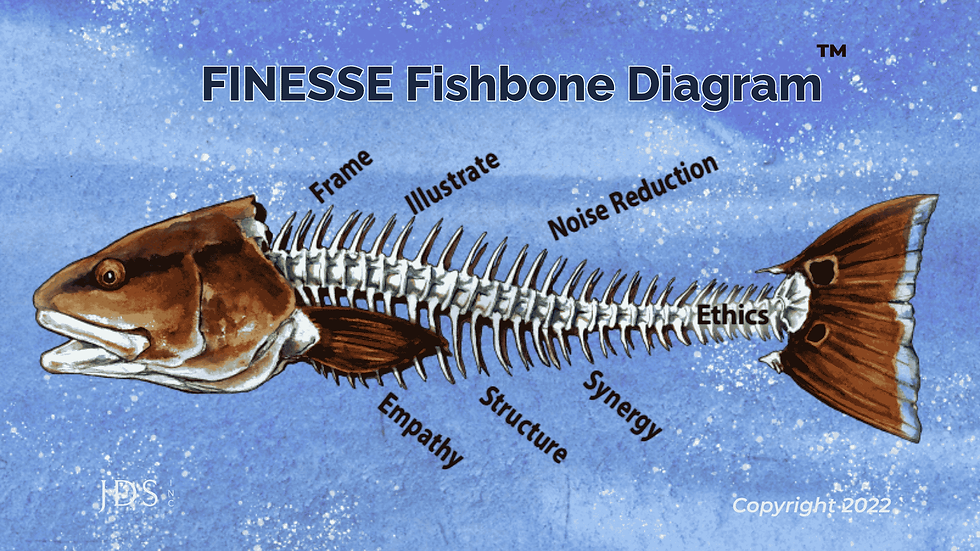
Complex, high-stakes technical decisions do not get resolved in one meeting. They move through gatekeepers over months or years. Big decisions pass through staff teams, multiple committees, stakeholders, and finally a decision board. Technical professionals tell the story at every stop, and the same story has to hold. The FINESSE Fishbone Diagram provides a proven, formal communication approach.
The Trap
Being consistent is the trap most technical communication falls into. We’re taught by marketing and sales professionals to evaluate the audience, tailor the message, and persuade, meeting each audience where they are.
That works for a single sale to a single buyer. It does not work when the same person hears three different versions of the same request eighteen months apart. Decision makers remember, especially when the decisions are big and uncertainty keeps the information shifting. The moment the numbers shift to fit the audience in the room, credibility is gone. It does not come back.
Technical professionals must be true to the data and information first, and the audience second, when uncertainty and complexity are elevated.
Control the Inputs, Get the Output
The cause-and-effect FINESSE Fishbone Diagram® treats communication as a system. Systems thinking, in part, tells us to identify and control the causal inputs, and the process will produce the right output: in this case, effective communication.
The inputs are the seven “bones” (causal factors) of FINESSE: Frame, Illustrate, Noise Reduction, Empathy, Structure, Synergy, and Ethics.

A powerful advantage of FINESSE is that the technical professional does not have to be a naturally gifted communicator. We have to manage the inputs correctly and trust the system to produce the result. It’s the same discipline used on any system process with too many variables to manage one at a time.
Systems thinking and the FINESSE Fishbone Diagram® only work if the context is right first. A cause-and-effect model built around the wrong problem runs cleanly and still solves nothing useful. FINESSE is a formal communication approach for big decisions with high levels of uncertainty and complexity; it is not intended for day-to-day operational decisions or emergency communication.
Why the Fishbone Splits the Work
FINESSE also draws a hard line between what has to stay fixed and what is allowed to flex. Frame, Illustrate, and Noise Reduction sit on the top fin of the diagram. They are about the data and the problem itself, and they do not change no matter who is in the room. The same numbers, the same information, and the same frame. Presentation after presentation.

Empathy, Structure, and Synergy sit on the bottom fin. They are about the audience, and they are where the adjustment happens. How you open, what you emphasize first, who you bring into the meeting with you. None of that changes what is true. It changes how clearly the truth resonates with the person in front of you.
Ethics is the tail fin of the fish, providing the power. It is the way we make decisions, and it is the discipline that keeps flexibility on the audience side from creeping into the information side.
Being a Trusted Advisor Requires Something Different
A technical professional who is true to the data and adaptive with the audience can walk into the fourth gatekeeper meeting having said something consistent each time. A car salesman does not need that discipline. He only has to close the person in front of him once, and he never has to answer to that person again next quarter.
The Edge: Advisor, Not Simply An Expert
None of this works because the FINESSE Fishbone Diagram® is clever. It works because of systems thinking. It works because it is formal enough to survive months or years of gatekeepers and specific enough to run the same way every time.
As a formal communication approach, FINESSE earns trust across the whole life of a complex decision, not the sales pitch in any single meeting. Executive leadership calls back the person who executes with FINESSE for the next hard call, and that is what a trusted advisor actually is.
A FINESSE Workshop Follow-up
Six months after one of our “Communicating to Decision Makers” workshops, I received an email from a mid-level process engineer at a major food processing company.
“JD, I just wanted to follow-up form the workshop. I put the approach to work on one of my projects. My manager had some hesitation at first, especially related to things like sharing the information in advance and getting to the conclusions in the beginning. But the management team loved it. My manager has now put me leading a team to improve all of our communication to executives. I just wanted to say thanks. Andy.”
Andy followed a formal communication approach. He didn’t say he was a perfect presenter. He trusted a system and an approach.
Are You Communicating with FINESSE?
The specific communications approach matters less than having one. Tips without an approach are a list, not a system. Tips tell you what to try, not when to use it. FINESSE is one formal communications approach for problems with real complexity and uncertainty. If it does not fit, find another and use it. What does not survive a multi-year decision is good intentions and a series of tips strung together.
Are you manipulating the decision maker into your way of thinking, or are you a trusted advisor?
JD Solomon is the founder of JD Solomon, Inc., the creator of the FINESSE Fishbone Diagram®, and the co-creator of the SOAP criticality method©. He is the author of Communicating Reliability, Risk & Resiliency to Decision Makers: How to Get Your Boss’s Boss to Understand and Facilitating with FINESSE: A Guide to Successful Business Solutions.


Comments